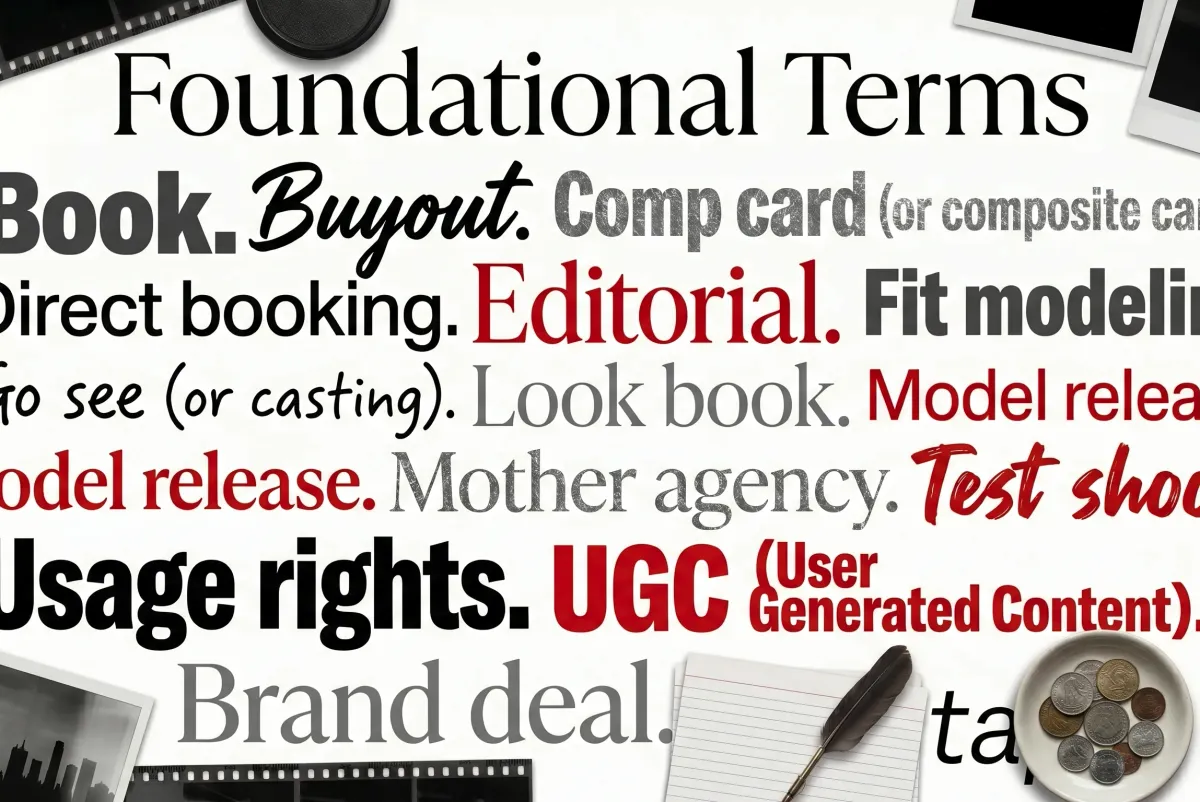
The modeling industry has its own working vocabulary, much of which gets used in casting briefs, contracts, and on set conversation without explanation. New models who do not know the terminology end up either pretending to understand or asking awkward questions that signal inexperience. This glossary covers the terms working models actually encounter in 2026, including some that have emerged or shifted meaning since the older glossaries were written.
Foundational terms
Book. A traditional or physical portfolio. Less central in 2026 than it was a decade ago, but still used in editorial and high end commercial contexts.
Buyout. Compensation for granting the client perpetual usage rights to an image or video. Higher fee than standard usage but resolves all future usage questions. Becoming more common as brands want flexibility.
Comp card (or composite card). A printed marketing card showing 4 to 6 of the model's strongest portfolio images plus measurements and contact info. Functions as a business card for models. Still used in many casting contexts; less universal than it once was.
Direct booking. Booking by a client without agency mediation, typically through a direct to client marketplace, social media DM, or direct outreach. Increasingly common in 2026 across many segments.
Editorial. Published work in a magazine or major online publication. Usually pays less than commercial advertising but produces prestigious tear sheets and portfolio assets.
Fit modeling. Modeling specifically for sizing and fit checks during garment development, typically at brand offices rather than on photo shoot sets. Steady work with a smaller pool of qualified models because precise measurements and consistent body shape over time matter.
Go see (or casting). An audition where models meet with clients or casting directors to be considered for a specific job. Now often happens via video call or self tape submission rather than in person.
Look book. A brand's catalog of seasonal styling, often shot with a small group of models, used for marketing and retail buying. Steady work for commercial models.
Model release. The legal contract giving a client or photographer rights to use the model's image for specified purposes. Always read before signing; never sign without specified usage and compensation.
Mother board. A modeling agency's primary roster of represented models. Being "signed to the mother board" means the agency represents the model directly rather than through a development or freelance arrangement.
Test shoot. A non paid (or low paid) shoot where models work with photographers to produce portfolio images for both parties. Common for new models building portfolios; the value comes from the resulting images, not the rate.
Usage rights. The specific permissions granted to a client to use images: where they can run (web, print, broadcast), for how long (30 days, 1 year, perpetual), in what geography (regional, national, global). Major driver of rate beyond base shoot fee.
Newer terms worth knowing
UGC (User Generated Content). Content the model creates and the brand licenses or pays for, typically for use in the brand's own social channels and marketing. A growing booking category that did not exist in the 2018 era playbook. Usually paid less per asset than traditional production but with much faster cycle and no on set production overhead.
Brand deal. A creator partnership with a brand for sponsored content on the creator's own social channels, with rates ranging from product compensation only at the nano tier to substantial cash partnerships at the macro tier. Now a major income category for working models with social presence.
Self tape. A casting submission recorded by the model at home, following a creative brief, and submitted through a casting portal or directly to a casting director. Replaced a substantial share of in person castings since 2020, particularly for commercial and brand work.
Engagement rate. Likes plus comments divided by followers, expressed as a percentage. The metric brands evaluate when considering creators for partnerships. Now more important than raw follower count for most brand deal pricing.
Exclusivity. Contract terms preventing the model from working with competing brands or in competing categories during the contract period. Common for major brand campaigns. Increases the rate substantially because it limits the model's other booking opportunities for the contract duration.
Casting platform. Centralized online portals where casting directors post briefs and models submit through standardized formats. Major casting infrastructure now runs through platforms like Cast It, Breakdown Express, and Talent Systems for film and TV; modeling industry equivalents for fashion and commercial work.
Vertical content. Content shot in 9:16 aspect ratio for {{PLATFORM_LINK:tiktok:TikTok}}, Instagram Reels, and {{PLATFORM_LINK:youtube:YouTube}} Shorts. Now a standard content category that most modern shoots produce alongside traditional 16:9 horizontal video.
The vocabulary keeps evolving as the industry shifts. Models who pick up new terms quickly come across as informed; models who do not ask questions end up making mistakes that more verbose models avoid. Asking what an unfamiliar term means is fine; pretending to understand and getting it wrong on set damages the working relationship.