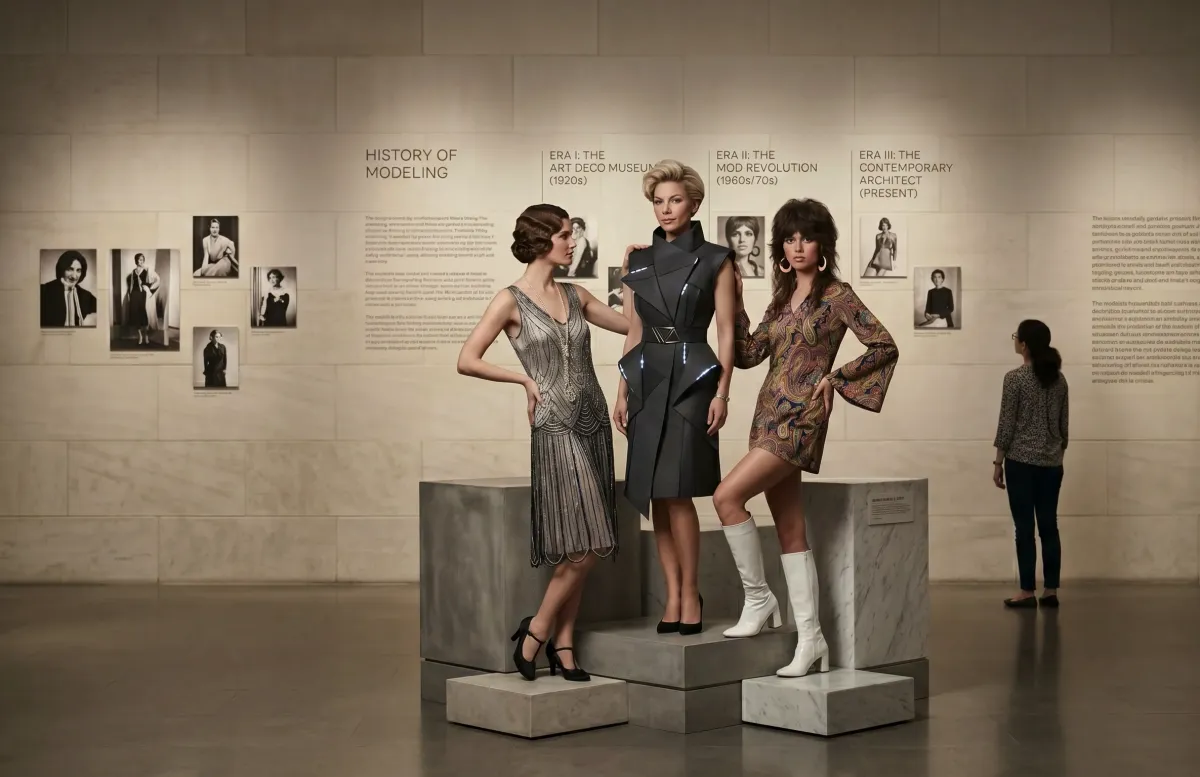
The modeling industry has a longer history than the 1990s supermodel era that dominates popular memory of it, and a substantially more complex evolution than the linear "agencies discovered models, models became famous" version. Understanding the industry's history helps working models contextualize the contemporary landscape: many of the structural features of today's industry are products of specific historical moments, and the recent shifts (post 2010 social media, post 2017 representation, post 2020 platform economics) continue patterns that have been evolving for over a century.
This article walks through modern modeling history with focus on the structural shifts that produced today's industry rather than the celebrity model biographies that public coverage tends to emphasize.
The structural moments that built today industry
The 1850s to 1900: the haute couture origin. The modern fashion industry emerged in 1850s Paris with Charles Frederick Worth, who is widely credited as the first couturier to use live models (mannequins) to display garments to clients rather than presenting flat designs. The practice of brands using human models to display their products dates to this period. The earliest professional models were employees of fashion houses rather than independent professionals.
The 1920s and 1930s: photographic modeling emerges. The development of fashion photography in magazines (Vogue founded 1892 but became substantively photographic in the 1910s and 1920s) created modeling work distinct from in person fashion presentation. The photographic modeling segment grew substantially through the 1930s as advertising photography expanded beyond fashion into broader consumer marketing.
The 1940s and 1950s: agencies professionalize the industry. Eileen Ford founded Ford Models in 1946; John Casablancas founded Elite in 1972 (after working with John Robert Powers, who had founded the first modern modeling agency in 1923). The agency model created the structural infrastructure that organized modeling as a professional industry: standardized booking processes, paperwork, payment infrastructure, talent development, and the relationships between models and clients that defined the industry through the late 20th century.
The 1960s: the cultural shift toward distinctive personalities. The 1960s introduced models with distinctive personalities and visible counter cultural identities (Twiggy, Jean Shrimpton, Verushka). The shift from interchangeable mannequins toward named distinctive personalities began the celebrity dimension of modeling that would intensify through the following decades.
The 1980s and 1990s: the supermodel era. The convergence of magazine prominence, fashion advertising budgets, music video, and television produced the supermodel phenomenon (Naomi Campbell, Linda Evangelista, Cindy Crawford, Christy Turlington, Claudia Schiffer, Tyra Banks). Top models commanded fees that approached celebrity entertainment compensation; modeling became culturally visible at a scale it had never previously achieved.
The 2000s: globalization and the e commerce expansion. Growth of e commerce produced a massive expansion in commercial modeling demand: every direct to consumer brand needed product imagery, every retailer needed catalog photography, every brand needed lifestyle shots for digital advertising. The expansion broadened the industry beyond the high fashion editorial focus that had defined the supermodel era.
The 2010s: social media reshapes everything. Instagram (2010), the rise of influencer marketing, the broader creator economy, and the shift toward direct to consumer brand marketing produced the current industry structure. Models could now build audiences directly without agency mediation; brands could discover and book talent through social channels; the influencer economy emerged as a parallel modeling segment with its own economics and career paths.
The 2017 representation shift. Sustained pressure on industry diversity and inclusion (post 2014 Black Lives Matter, post 2017 representation activism, dedicated advocacy from organizations like the Model Alliance and the CFDA) shifted casting practices substantially. The narrow physical specifications that had defined high fashion modeling for decades broadened in ways that opened careers for models previously excluded from the industry.
The 2020 platform economics shift. Pandemic disruption accelerated several existing trends simultaneously: remote casting normalized (self tape submissions for substantial portions of commercial work), direct to client marketplaces emerged as legitimate booking channels, subscription content platforms became a real revenue segment for working models, and the geographic concentration of the industry in NYC and LA loosened with the rise of secondary markets like Atlanta, Austin, and Miami for production work.
Why this history matters for working models today
The contemporary modeling industry is the product of accumulated structural decisions made across 170 years of evolution. Understanding the history matters for working models because:
Many "industry standards" are historical artifacts, not necessities. The narrow height and body type specifications for high fashion came from specific decisions in the mid 20th century about how clothing displayed best in catalog photography, not from any inherent visual logic. The agency model with 15 to 25 percent commission rates came from specific negotiation between agency founders and early industry clients, not from any law of nature. Models who understand which industry standards are arbitrary historical decisions navigate the industry differently from models who assume current standards are permanent.
The shifts that defined recent decades continue. The post 2010 social media shift, the post 2017 representation shift, and the post 2020 platform economics shift are still in motion. Models building careers in 2026 are working in an industry that continues to evolve in ways that will produce different structural features by 2030. Recognizing that the industry is in motion rather than fixed helps working models position for emerging opportunities rather than chase the patterns that worked 5 years ago.
Career length expectations should be calibrated to history, not to outliers. The supermodel era produced a small number of careers that extended into long term celebrity status; this is the public memory of modeling careers. The realistic median career length across the industry has historically been 5 to 15 years productive work. Models who plan for the realistic distribution rather than the celebrity outliers handle career length transitions more smoothly.
The industry that exists today reflects 170 years of evolution. The industry that will exist in 2030 will reflect another 4 years of continued evolution, including changes already in motion (AI generated imagery, platform economics shifts, ongoing representation work, new segments emerging from new platforms). Working models who understand the industry as a continuously evolving structure rather than as a fixed thing position better for sustainable careers across the changes still ahead.